



How to Plant Italian Cypress Trees for a Tall, Elegant Landscape
Italian cypress, or cupressus sempervirens, is the tall, dark green conifer many people associate with mediterranean landscapes, villa entries, and California estates. Also called mediterranean cypress or tuscan cypress, it has evergreen foliage, a naturally narrow silhouette, and a formal presence that works in both classic and modern gardens.
Here’s the short version of italian cypress planting: choose full sun, well drained soil, and a site with enough room for the mature width; dig a wide hole; set the top edge of the root ball slightly above surrounding soil level to prevent trunk rot; backfill carefully; water deeply; mulch; and let the tree establish.
Yardwork helps California homeowners and designers source italian cypress trees, privacy trees, shrubs, perennials, and jumbo trees, with plant delivery, soil testing, and layout advice for a better outdoor space. This guide covers site selection, planting steps, spacing, watering, care, pruning, containers, design ideas, and common problems.

Why Choose Italian Cypress for Your Landscape?
Italian cypress trees create instant structure: tall vertical lines, dense foliage, and year round greenery without the broad canopy of many other trees.
-
Use italian cypress as a space-saving vertical accent for tight spaces and narrow spaces.
-
Plant italian cypress trees to frame entries, pools, patios, gates, and long walkways with a stately, elegant look, especially near Mediterranean-style architecture.
-
Italian Cypress trees can be planted in rows to form a dramatic focal point or a formal hedge, enhancing the structure of a garden or landscape design.
-
Compared with other evergreen trees, italian cypress trees grow 30–60 feet tall in many landscapes, stay roughly 3–5 feet wide, and have a growth rate of about 1–2 feet per year, or up to 3 feet per year when young if properly maintained.
-
Italian Cypress trees are often used to create natural privacy screens due to their tall, narrow form, making them ideal for tight spaces in landscaping.
-
Italian cypress is especially suited to California and other dry climates with hot, dry summers.
-
Yardwork customers often choose these trees as an elegant alternative to fences for privacy.
Italian Cypress Tree Characteristics (Cupressus sempervirens)
cupressus sempervirens originated around the Mediterranean and remains popular because its narrow form delivers height without taking over the yard. Italian cypress trees typically reach 30–60 feet tall, with a mature width near 3–5 feet, depending on cultivar and soil.
The foliage is scale-like, dense, and dark green to blue-green. The tree’s columnar shape is naturally narrow, so it usually needs less shaping than many cypress trees. Italian Cypress is well-suited for warm, Mediterranean-like climates and thrives in USDA zones 7-11, tolerating high temperatures and some drought once established.
-
Typical growth rate: 1–2 feet yearly, faster in ideal conditions.
-
Narrow spread: useful where trees grow near paths or property lines.
-
Best performance: full sun, good air circulation, and proper care.
Ideal Site and Soil Conditions for Italian Cypress
Italian cypress trees thrive in full sun and well-drained soil, especially in warm, dry regions, making them one of several popular evergreen privacy trees. Italian Cypress trees thrive in full sun and require at least 6-8 hours of direct sunlight each day to encourage dense, healthy growth.
-
Light: provide direct sunlight and 6–8 hours of sunlight daily. Shade can cause sparse sides, weak new foliage, and uneven growth.
-
Soil: Italian Cypress trees prefer well-draining soil with a slightly acidic to neutral pH (6.0-7.5) and can tolerate various soil types, including sandy and clay soils, as long as drainage is adequate.
-
Drainage: heavy, wet clay is risky because poor soil drainage can cause root rot.
-
Wind: choose a site with some wind protection for young or tall trees to reduce leaning and breakage.
-
Test: dig a hole, fill it with water, and watch how quickly it drains. If water lingers, mound the planting area, add coarse mineral material, or improve drainage before planting.
Yardwork soil testing can confirm pH, texture, and drainage before you plant a row. If the soil is too wet, we can recommend amendments, organic matter used carefully, or alternative evergreen trees.
How to Plant Italian Cypress Trees Step by Step
This is the core how-to plant italian cypress guide for new projects and replacement plantings.
-
Unpack the nursery tree, inspect the root ball, and moisten it before planting.
-
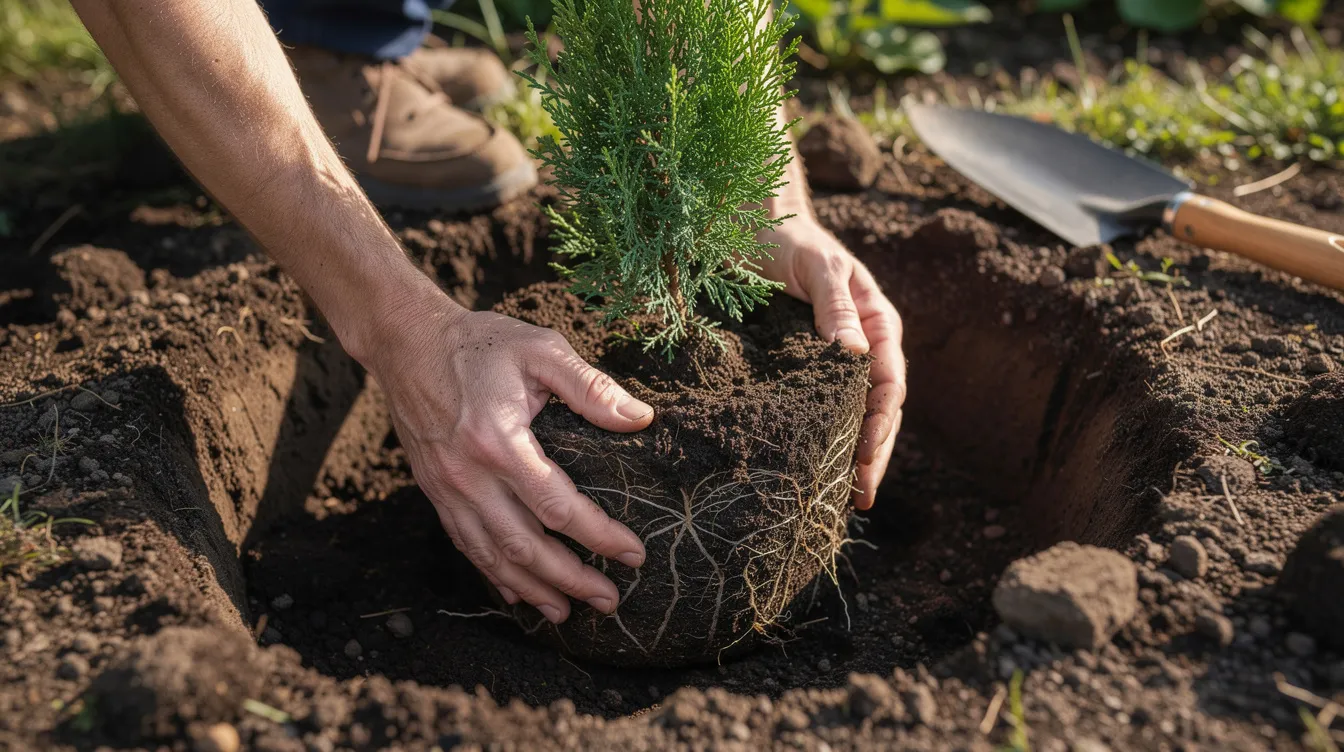
Dig a hole twice as wide as the root ball for Italian cypress trees to allow the shallow root system to spread easily; 2–3 times as wide is even better. Keep the hole only as deep as the root ball.
-
Set the tree straight. The root flare should sit level with or slightly above grade.
-
Loosen circling roots by scoring or teasing them gently.
-
Backfill with native soil in layers. Firm lightly to eliminate air pockets, but do not compact the soil hard. Avoid creating new air pockets as you finish.
-
Build a shallow basin and water deeply until the full root zone is moist.
-
Add 2–3 inches of mulch. Mulch around the base of Italian cypress trees helps retain moisture and regulate soil temperature, while keeping the mulch away from the trunk to prevent rot.
-
Stake only in windy sites or for top-heavy young trees, then remove stakes within 6–12 months.
Plant italian cypress trees in the fall or early spring to allow roots to establish during winter dormancy.
Spacing and Layout: How Far Apart to Plant Italian Cypress
Correct spacing affects how italian cypress trees grow, whether you want a formal allee, hedge, or privacy screen.
|
Use |
Recommended spacing |
|---|---|
|
Dense privacy wall |
3 feet apart |
|
Privacy screen or property line |
4–6 feet apart |
|
Driveway or walkway row |
6–8 feet apart |
|
Individual trees |
5 to 10 feet apart |
|
Specimen focal point |
8–10 feet or more |
|
For a dense privacy wall, space Italian cypress trees 3 feet apart; for individual trees, space them 5 to 10 feet apart. Keep the root system away from foundations, walls, utilities, and paving. Even with a narrow shape, roots need enough room. |
|
For larger rows, sketch the layout first or request a Yardwork consultation to align italian cypress, olive trees, lower shrubs, and drought-tolerant perennials.
Watering Italian Cypress: Establishment and Long-Term Care
Italian cypress is drought tolerant once established, but young trees need consistent water. Water deeply once or twice a week for the first few months after planting Italian cypress trees. In hot weather, you may water 2–3 times weekly at first, then taper to weekly deep watering for the first 1–2 growing seasons, especially if you’re growing other thirsty plants like citrus fruit trees.
To water italian cypress trees correctly, use drip irrigation or a soaker hose at the root zone and soak 12–18 inches deep. Avoid shallow sprinkling.
-
Underwatering: tips turn brown, foliage thins, growth slows.
-
Overwatering: yellowing, soggy soil, dieback, and root rot.
-
Avoid overhead watering for Italian cypress trees to prevent fungal diseases.
Italian Cypress trees prefer to grow in dry conditions and should be watered regularly until established; mature trees are drought-resistant and usually thrive with average rainfall amounts in their growing zones. Mature trees often need minimal watering except during late summer heat or extended drought.
Ongoing Italian Cypress Care: Light, Soil, Fertilizer, and Climate
Once established, italian cypress is low maintenance. Keep trees in full sun and prevent future shade from buildings or other trees.
Italian cypress adapts to many well-drained soils, and heavy feeding is usually unnecessary. Apply a balanced, slow-release evergreen fertilizer once a year in early spring to support growth of Italian cypress trees, especially if a soil test shows low nutrients.
These trees handle high temperatures, dry summers, and coastal exposure, but very wet winters are harder on them. In colder microclimates, provide winter protection from drying wind and frost damage. Refresh mulch annually to conserve moisture and moderate soil temperature without burying the trunk.
Pruning and Shaping Italian Cypress Trees
Italian cypress keeps the tree’s natural shape with very little pruning. Occasional trimming can help keep them tidy and remove dead, damaged, or diseased branches, ideally done in late winter before active growth; early spring cleanup is also acceptable.
Avoid heavy pruning and do not cut into bare brown wood with no green foliage, because italian cypress may not resprout there. For desired height control, avoid harsh topping. If necessary, make a small conservative cut at the leader, knowing it can permanently change the narrow form.
For formal rows, light shaping can keep a uniform outline. For very tall, mature trees, hire a professional or ask Yardwork for guidance.
Growing Italian Cypress in Containers and Small Spaces
Italian cypress, including compact options like the Tiny Tower® Italian Cypress, can grow in large pots on patios, entryways, and rooftop gardens if drainage is excellent. Use heavy containers with multiple drainage holes and a well-draining mix with perlite, pumice, or sand.
Potted trees dry faster than in-ground trees. Let the top inch of soil dry, then water deeply. Repot every 2–3 years in fall or winter, refreshing soil and checking the root ball; this routine is similar for other container evergreens such as Monterey Cypress.
-
Root prune periodically if container-bound.
-
Lightly prune the canopy to maintain balance.
-
Move containers to sheltered spots in marginal climates for wind and winter protection, especially for more tender trees like a Valencia orange tree.
Using Italian Cypress in Landscaping and Design
Italian cypress tree plantings are versatile in formal, Mediterranean, and modern landscapes. Use them to line a driveway, frame gates, flank doors, or create symmetry beside garages.
You can also plant italian cypress as a living privacy wall or windbreak, then layer shorter privacy trees, shrubs, rosemary, lavender, sage, and perennials in front. Pairing italian cypress with fruitless olive trees creates a cohesive Mediterranean look.
-
In California landscapes, italian cypress adds low-water evergreen structure, curb appeal, and vertical rhythm.
-
For full yard makeovers, Yardwork can help plan spacing, companion plants, and plant delivery.

Common Problems with Italian Cypress and How to Avoid Them
Most problems come from poor planting, poor drainage, or incorrect watering rather than inherent weakness.
Uneven foliage often happens when trees are too close to walls, fences, or shade from large trees. Allow sun on all sides where possible.
Overwatering Italian Cypress trees can lead to root rot, causing leaves and branches to turn yellow and die back; it is important to water at the base of the tree to prevent fungal infections. Poor drainage can also invite fungal diseases and fungal infections.
Watch for spider mites, bronzing, fine webbing, bagworms, and hanging bags. For identification and control basics, see the UC IPM spider mite guide. Cypress canker may cause sunken branches and dieback; prune infected wood with sterilized tools.
-
Size issues: avoid narrow beds where mature trees lack room.
-
Wind issues: stake young trees only when needed and correct lean early.
Frequently Asked Questions About Planting Italian Cypress
How fast do italian cypress trees grow?
Italian cypress trees grow about 1–2 feet per year in good conditions, and young trees can grow up to 3 feet per year when properly maintained. A privacy screen may take several years to fill in.
When is the best time for italian cypress planting?
Fall through early spring is best in mild climates. Avoid peak summer heat when possible.
Can italian cypress grow near pools, patios, or driveways?
Yes, but respect the root system, narrow spread, debris, and mature size. Give trees enough room from hardscape.
Should I grow from seed or buy nursery trees?
Seed-grown trees vary in shape. Container-grown Yardwork trees give more predictable columnar shape and faster results.
Is italian cypress cold hardy in wet or cold regions?
It is cold hardy mainly within suitable usda zones, but very wet soil and severe freezes are problems. In those sites, consider alternative evergreen trees. You can check your area using the USDA Plant Hardiness Zone Map.
Yardwork Help: Choosing, Planting, and Caring for Italian Cypress
Yardwork supports homeowners, designers, and landscapers who want italian cypress trees in California and beyond. We offer online ordering, plant delivery, privacy trees, companion shrubs, drought-tolerant perennials, and mature trees for instant impact.
Before planting long rows, use Yardwork soil testing to confirm drainage and nutrient status. For privacy screens, driveways, or a full yard makeover, request a landscaping consultation for spacing, layout, and plant selection through our plant nursery and landscape services.
Ready to build a taller, cleaner, more elegant landscape? Visit Yardwork to shop for Italian cypress trees, companion shrubs, olive trees, and low-water perennials.