



A healthy avocado tree can turn a California yard into a practical, beautiful food garden. But success depends on choosing the right variety, planting it in the right place, and giving it consistent care through the early years.
This guide walks through what homeowners need to know before growing avocados at home: how long trees take to crop, why Hass is so popular, how to avoid root problems, and how Yardwork can help you select, plant, and maintain a productive tree. If you searched for “avocados tree” because you want your own fruit, start here.
Quick Start: How Long Until an Avocado Tree Produces Fruit?
Most grafted avocado trees in California take about 3–4 years to produce fruit after planting. Seed-grown trees are a much slower gamble: avocado seeds can take 5–13 years to bear fruit, and the resulting tree may never match the flavor, texture, or reliability of a true Hass.
That is why a young Hass avocado tree purchased from a reputable nursery like Yardwork is the fastest, most reliable path to homegrown avocados. A grafted tree gives you a known variety, earlier fruit production, and a root system selected for garden performance.
Here is a simple timeline:
-
Year 1: the tree focuses on feeder roots, root/branch growth, trunk strength, and leaf canopy.
-
Years 2–3: young avocado trees may show first blossoms, first fruit, and light fruit set.
-
Years 4–5: a well-grown tree can move into heavier crops as the canopy, tree trunk, and root system mature.
Avocado trees need enough trunk caliper, healthy small branches, and stable roots before they can hold a meaningful crop. If the tree is too small, weak, shaded, or stressed, it may flower but fail to set fruit.
Under good care, a mature avocado tree in coastal California may produce 30–100+ Hass avocados per year. In warmer inland areas, mature trees with excellent irrigation and nutrition may produce more, though heat stress and water management become more important.
Common reasons avocado trees fail to produce fruit include:
-
Heavy shade instead of full sun
-
Poor drainage or soggy soil
-
Aggressive pruning that removes flowering wood
-
Frost damage during bloom
-
Nutrient deficiencies, especially nitrogen or zinc
-
Fruit drop during stress, heat, or irregular watering
Choosing the Right Avocado Tree Variety (With a Focus on Hass)
Variety selection is the most important decision for home growers. California includes foggy coastal neighborhoods, hot interior valleys, mild southern california yards, cooler santa cruz counties sites, and inland regions near the sierra nevada mountains. The right tree for san diego may not be the same as the right tree for san francisco or fresno and tulare counties.
The Hass avocado is one of the most popular varieties, known for its creamy texture and rich flavor, making it a favorite among consumers and growers alike. It dominates the avocado industry because it has high oil content, a long harvest window, durable pebbly skin, and a recognizable dark color as the fruit matures. High oil content does not mean too much oil; it means a rich eating quality and nutty flavor when the fruit is mature.
Here is a practical comparison:
|
Variety |
Flower type |
Cold tolerance |
California fruit season |
Flavor and fruit notes |
|---|---|---|---|---|
|
Type A |
Sensitive in hard freezes; established trees may tolerate temperatures near 28°F–32°F briefly |
Often spring through summer, depending on region |
Rich, creamy, dark pebbly skin; classic hass avocado flavor |
|
|
Type B |
More cold tolerant than Hass |
Winter to spring |
Smooth green skin, elongated fruit, buttery flavor |
|
|
Type B |
Fairly cold tolerant |
Early winter |
Mild flavor; often used as a pollinizer and early season fruit |
|
|
Type A |
Moderate |
Summer to fall |
Round, larger fruit with good texture |
|
|
Type A |
One of the cold hardy varieties |
Late summer to fall |
Smaller fruit, thin skin, pronounced nutty flavor |
|
|
Holiday |
Type A |
Cold-hardy avocado varieties, such as the Holiday avocado, are suitable for cooler climates and can withstand lower temperatures compared to other types |
Often late season |
Compact habit, useful where small trees are preferred |
|
Lamb Hass |
Type A |
Similar to Hass, slightly later |
Summer to fall |
lamb hass can produce larger fruit and a later harvest window |
|
|
|
|
|
|
If you have room for multiple trees, plant complementary avocado varieties. If you only have room for one, choose a grafted Hass or another variety matched to your microclimate.
Mature Hass avocado trees commonly reach 15–30 feet tall with regular pruning, and they can grow larger if left unmanaged. Yardwork can help homeowners choose standard, compact, or columnar forms for smaller yards, tight side yards, or edible landscape designs.
Avoid unknown seedlings from random garden supply centers when your goal is reliable avocado production. Grafted nursery trees give you known fruit quality, earlier production, and a better chance of long-term success. Groups such as the california rare fruit growers and the california avocado society are useful educational resources, but for planting stock, start with reputable nurseries and disease-free trees.

Planting an Avocado Tree in California: Site, Soil, and Timing
Avocado trees are shallow-rooted, sensitive to poor drainage, and happiest in warm, bright locations. Avocado trees thrive in well-drained soil and full sun, which are essential conditions for their growth and fruit production.
Avocado trees thrive in warm, frost-free climates, specifically USDA Zones 9-11. Successful avocado cultivation depends on the replication of subtropical conditions, focusing on frost protection, excellent soil drainage, and consistent moisture. Avocado trees thrive in moderately warm temperatures ranging from 60°F to 85°F and can tolerate temperatures as low as 28°F to 32°F once established.
In most of California, the best planting window is March–June, once the soil is warming and the risk of hard frost has passed. Coastal gardens can sometimes plant into early fall, but inland growers should avoid exposing brand-new young trees to extreme summer heat without a strong irrigation plan.
Choose a site with:
-
At least 6–8 hours of direct sun
-
Protection from prevailing hot winds
-
Good drainage after winter rain
-
Space away from lawns, sidewalks, driveways, and structures
-
Enough room for harvesting and picking fruit safely
Avocado trees can grow in sandy or clay soils but require well-aerated conditions to avoid root suffocation. The ideal soil pH for avocado trees is between 6 and 6.5, and if heavy clay soil is present, it is recommended to plant the tree in a mound for better drainage. Sandy soil is usually easier to manage if it holds enough moisture; heavy clay soil needs more care.
For clay or slow-draining sites, build a mound:
-
1–2 feet high
-
3–5 feet wide
-
Broad and gently sloped, not a narrow volcano
-
Made with native or similar mineral soil, not fluffy stuff that collapses quickly
When planting an avocado tree, it is important to dig a hole as deep as the current root ball and just as wide, ensuring good aeration for the shallow-rooted tree. Do not dig an extra-deep hole, and do not add gravel at the bottom. Gravel can create a perched water table and make drainage worse.
Basic planting steps:
-
Water the nursery pot before planting.
-
Dig a hole just as wide and deep as the root ball.
-
Slide the tree out carefully without breaking the root mass.
-
Set the root ball slightly above finished grade.
-
Keep the graft union and trunk flare above soil level.
-
Backfill with native soil only.
-
Water deeply to settle soil around the roots.
-
Add mulch, but keep it away from the trunk.

Most avocado feeder roots sit in the top 6 inches of soil, so avoid compacting the soil under the canopy. Do not drive over the root zone, pile bulk soil against the trunk, or bury the graft union.
Plant standard avocado trees 15–25 feet apart when you want them to grow as individual trees. Tighter spacing can work in urban gardens if you commit to regular pruning, but the design should be intentional. Yardwork can help plan spacing when several avocado varieties present are part of a larger yard design with shrubs, perennials, privacy trees, or evergreen trees.
Do:
-
Plant in full sun.
-
Use mound planting on heavy clay.
-
Keep mulch off the trunk.
-
Water deeply after planting.
-
Protect young trees from frost and wind.
Don’t:
-
Plant in a low swale that collects water.
-
Bury the tree trunk or graft union.
-
Mix large amounts of compost into the planting hole.
-
Add gravel under the root ball.
-
Plant where sprinklers keep the trunk wet.
Watering, Mulching, and Fertilizing to Help Trees Bear Fruit
Consistent moisture and balanced nutrition are critical for healthy growth, flowering, fruit retention, and reliable fruit set. Avocados dislike both drought stress and soggy roots, so the goal is steady moisture with air in the soil.
Watering should be deep and infrequent, allowing the soil to dry out slightly before subsequent watering. Avocado trees require watering two to three times a week initially, which can be reduced to about once a week after a year as the roots extend into the bulk soil.
A practical watering pattern:
-
New plantings: water 2–3 times per week through the first summer.
-
After establishment: shift gradually to deeper soakings about once per week in warm weather.
-
Coastal sites: water less often during cool, foggy periods.
-
Hot inland sites: increase volume during heat waves, especially for mature trees.
In hot interior California, mature trees can require roughly 15–25 gallons per day during peak summer, depending on canopy size, soil, and weather. Deep drip irrigation or micro-sprinklers are usually better than frequent light sprinkling.
To check soil moisture:
-
Push a finger 3–4 inches into the soil.
-
Or squeeze a handful of soil from the root zone.
-
Moist soil should hold together lightly, not drip water.
-
Yellowing leaves can mean overwatering or poor drainage.
-
Wilted, curling avocado leaves often mean underwatering or heat stress.
-
Sudden leaf drop can follow drought, cold weather, root injury, or severe overwatering.
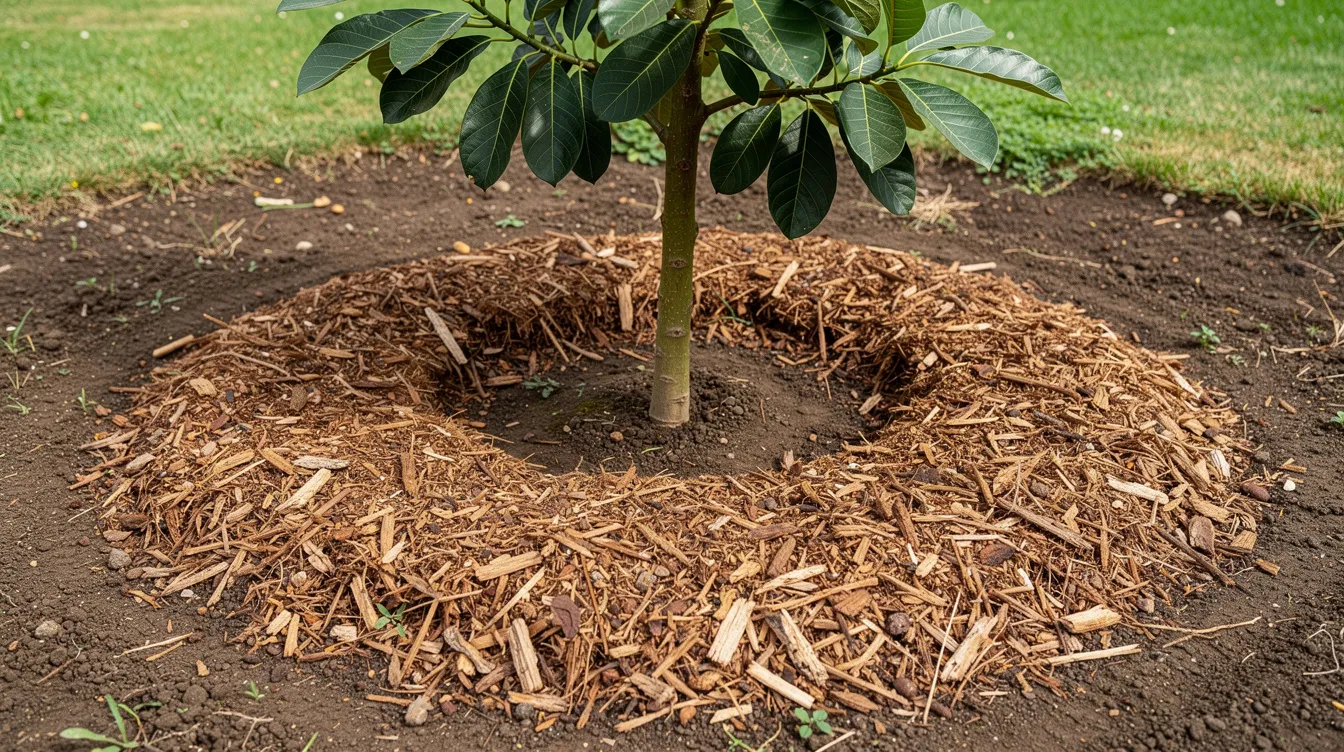
Mulching around the base of an avocado tree helps retain moisture and protect the roots from pathogens, but should be kept away from the trunk. Use coarse mulch such as wood chips, shredded tree bark, redwood bark, or coarse yard mulch in a 3–6 inch layer. Cocoa bean husks can also be used in some gardens, but avoid them where dogs or livestock may access them.
Keep mulch 6–12 inches away from the trunk to prevent collar rot, rodent damage, and fungal problems. Coarse mulch helps moderate root-zone temperature, reduce evaporation, and support the biological activity that benefits feeder roots.
Fertilizer basics:
-
Feed young trees lightly; sensitive roots can burn.
-
Use a balanced or citrus-type fertilizer during active growth.
-
Apply small amounts 2–3 times per year rather than one heavy dose.
-
Nitrogen supports canopy growth, but excess nitrogen can reduce flowering balance.
-
Zinc is often important for avocado production in California.
-
Avoid heavy manure piled near the trunk.
The CDFA avocado fertilization guidelines provide useful nutrient ranges for commercial and serious home growers. For homeowners, a Yardwork soil test is often the simpler first step because it can identify pH, salinity, drainage concerns, and nutrient gaps before you guess.
Case example: a southern california homeowner had brown tip burn and small avocado fruit through summer. After switching from shallow sprinklers to properly spaced drip irrigation, adding mulch, and adding complementary citrus fruit trees nearby while correcting zinc deficiency, the tree pushed healthier leaves and improved fruit size the following season.
Pruning, Training, and Managing Tree Size
Many avocado trees can reach 30–40+ feet tall if unmanaged. Thoughtful pruning keeps trees harvestable, attractive, and productive in home gardens.
The goal is not to force the tree into a rigid shape. The goal is to maintain a strong central framework of medium branches, encourage many leafy shoots for flowering and fruiting, and keep the canopy low enough that you can harvest from the ground or a short ladder.
Best timing:
-
Light shaping: after the last frost.
-
Heavier structural pruning: late winter or very early spring before the strongest growth flush.
-
Avoid heavy pruning during active bloom or early fruit stages.
Basic pruning cuts include:
-
Heading back excessively tall leaders.
-
Thinning crossing or shaded interior branches.
-
Removing weak, dead, or damaged wood.
-
Shortening branches that interfere with paths, driveways, or walls.
Avoid severe “lion-tailing,” where all the small branches are stripped from major limbs. This exposes bark to sunburn, reduces flowering wood, and weakens the tree’s ability to feed developing fruit.
Older wood along the outside canopy often carries the most flowers. Do not remove all productive outer branches in one season, especially if your tree is already carrying a crop. Spread major size reduction over several years if possible.
Low branches can be removed where they interfere with mowing or foot traffic, but keep enough foliage low on the trunk to shade bark. In hot interior California areas, exposed trunks or large limbs can be painted with white latex paint diluted with water to reduce sunscald after heavy pruning.
For tight urban lots, espalier-style experiments, or multi-tree hedgerows, Yardwork landscaping consultations can help set a pruning plan before small trees become oversized problems, especially when you’re also planning hardscape, groundcovers, or other plantings from a full-service plant nursery near you.
Flowering, Pollination, and How Avocado Trees Actually Set Fruit
Avocado flowers are small, greenish-yellow blooms that open twice in a day–night cycle. Each flower can function as female during one opening and male during another. This is why avocados are grouped into Type A and Type B flowering patterns.
Hass is Type A. It often bears fruit on its own in California, especially where bees and other pollinators are active. However, optimum fruit set occurs when bloom timing, weather, pollinators, and tree health all line up.
A Type A and Type B combination can modestly increase fruit set by providing overlapping male and female flower phases. This can be helpful in cool or cloudy coastal microclimates, where avocado flowering patterns fall out of sync because temperature affects bloom timing.
Main factors that improve fruit set:
-
Healthy leaf canopy
-
Adequate water during bloom without waterlogging
-
Balanced nutrition
-
Moderately warm temperatures during flowering
-
Bee activity and other pollinators
-
Nearby compatible varieties when conditions are marginal
A large avocado tree can produce about one million flowers, but only a tiny percentage become fruit. That is normal. Seeing many flowers drop does not automatically mean something is wrong.
The California Avocado Commission publishes grower research and regional information on bloom, pollination, and yield. Yardwork uses this type of regional knowledge when recommending varieties for different California sites.
Biennial bearing is also common. A tree with a heavy crop one year may produce a lighter crop the next year because the previous crop used so much energy. To help even out production:
-
Avoid drought stress during bloom and fruit sizing.
-
Do not over-prune after a heavy crop.
-
Maintain steady nutrition.
-
Thin young fruit only if branches are overloaded.
-
Keep records of weather, bloom, and harvest patterns.
Optimum fruit set is never caused by one factor alone. It is the result of the right tree, the right site, and steady care.
Growing Avocado Trees in Containers and Small Urban Spaces
Container-grown avocado trees make sense for patios, townhomes, renters, and very small yards. They can also help growers in colder valleys move trees into protected spots during hard freezes. The tradeoff is that container trees usually stay smaller and have more limited fruit production than in-ground trees.
Start with a 15–25 gallon container for a young tree, then move up as the tree grows. A fruiting container avocado may eventually need a much larger pot, such as 50 gallons or more.
Choose containers with:
-
Multiple large drainage holes
-
Durable sides that resist cracking
-
Enough weight or width to prevent tipping
-
Pot feet or risers so water can drain freely
Use high-quality, well-draining potting soil. Avoid dense native clay in containers. A good mix often includes bark, pumice, perlite, or other materials that keep air in the root zone.
Watering in pots is different. Containers dry faster, but the root ball can also stay saturated if drainage is poor. Check pot weight and moisture before watering. The top inch can dry slightly, but the entire root zone should not become bone dry during hot weather.
For containers, choose compact or semi-dwarf avocado varieties. Yardwork can recommend Hass and non-Hass options that stay manageable, including choices for patios and narrow spaces.
Container trees also need more regular feeding because nutrients leach out faster than they do in the ground. Use a slow-release fertilizer and occasional liquid feeding during active growth, but avoid over-fertilizing young roots.
In colder California valleys, protect potted trees by:
-
Moving pots against warm south-facing walls.
-
Wrapping containers during cold snaps.
-
Covering young trees during frost events.
-
Rolling trees indoors temporarily during hard freezes.
Pests, Diseases, and Common Avocado Tree Problems
Avocado trees are generally tough, but they can struggle with poorly drained soil, fungal diseases, and a handful of insect pests in California.
Phytophthora root rot is the most common killer of avocado trees and can be avoided through proper watering and soil drainage. Root rot is strongly associated with overwatering, heavy clay, compacted soil, and planting too deep. The UC IPM guide to Phytophthora root rot is one of the most useful references for symptoms and prevention.
Watch for:
-
Pale or yellow leaves
-
Slow growth
-
Wilting even when soil is wet
-
Sparse canopy
-
Dieback on branch tips
-
Smaller fruit than normal
-
Diseased roots that appear dark, brittle, or decayed
Prevention is much easier than rescue. Plant high, improve drainage, use disease-free nursery stock, mulch properly, and avoid keeping the root zone saturated.
Other disease issues include:
-
Sunblotch: a viral disease that can cause stunted growth and discolored branches.
-
Trunk cankers: often associated with wounds or stress.
-
Fruit rots: more common where humidity and canopy density are high.
Common insect pests include mites, thrips, borers, and scale. Many problems can be reduced through cultural control:
-
Prune out infested small branches.
-
Avoid unnecessary pesticide use that kills beneficial insects.
-
Clean up fallen fruit and dead wood.
-
Use targeted horticultural oils or insecticidal soaps only when needed.
Leaf symptoms are useful clues:
-
Brown tip burn often points to salts, irregular watering, or high-mineral irrigation water.
-
Yellow leaves may indicate excess water, nitrogen deficiency, or root problems.
-
Sudden leaf drop can follow drought, cold damage, or saturated soil.
-
Small, pale leaves can suggest nutrient issues or declining roots.
Avocado tree parts can be toxic to animals. Leaves, bark, and seeds may harm horses, some birds, and certain livestock. If you keep backyard animals, keep fallen avocado leaves, prunings, and pits out of their reach.
Persistent problems are a good reason to request a Yardwork consultation or soil test. Many avocado issues look similar above ground, but the real cause is often in the soil.
From Fruit on the Tree to Hass Avocado on Your Table
Avocados do not ripen on the tree. They are picked mature but firm, then softened indoors. In other words, avocados ripen after harvest, not while hanging on the branch.
For Hass, look for:
-
Darker, thicker skin
-
A slight loss of gloss
-
Expected fruit size for the season
-
Fruit that clips or twists off cleanly
-
Sample fruit that softens properly at room temperature
The best home method is sample-picking. Harvest one or two fruits and let them sit indoors around room temperature. If they soften evenly and taste good, the crop is ready. If they shrivel or stay rubbery, wait longer.
Harvest guidelines:
-
Use clippers or a pole picker.
-
Leave a short stem stub attached.
-
Avoid dropping fruit.
-
Keep firm fruit at room temperature until it yields gently to pressure.
-
Refrigerate ripe fruit to hold it for a few extra days.
-
Avoid chilling immature fruit.
Typical Hass harvest seasons vary by region. Coastal zones may harvest from late winter through summer, while hot inland valleys may start earlier. Microclimate matters, so two trees in the same city can mature at different times.
Use homegrown Hass avocados for guacamole, toast, salads, sushi, or sliced fresh with citrus and salt. To speed ripening, place firm avocados in a paper bag with other ripe fruit such as bananas or apples. To improve your timing over the years, track which branches ripen earliest and record your harvest windows.

How Yardwork Helps You Succeed With Avocado Trees
Yardwork is a California-focused online nursery and horticultural partner for homeowners, designers, and landscape professionals who want better plant choices and stronger results.
For avocado projects, Yardwork can help with:
-
Curated Hass and complementary avocado varieties
-
Expert recommendations matched to California microclimates
-
Plant delivery options for small and large orders
-
Soil testing for drainage, salinity, nutrients, and pH
-
Landscaping consultations for placement, spacing, and long-term care
Avocado trees work beautifully in edible landscapes alongside evergreen trees, fruitless olive trees, privacy trees, shrubs, perennials, and other fruiting species. The key is placing each plant where it has the light, soil, and space to thrive.
If you want your own avocados, start with the right tree and the right site. Browse avocado trees with Yardwork, request a soil test before planting, or schedule a consultation for a complete yard makeover built around homegrown Hass avocados.