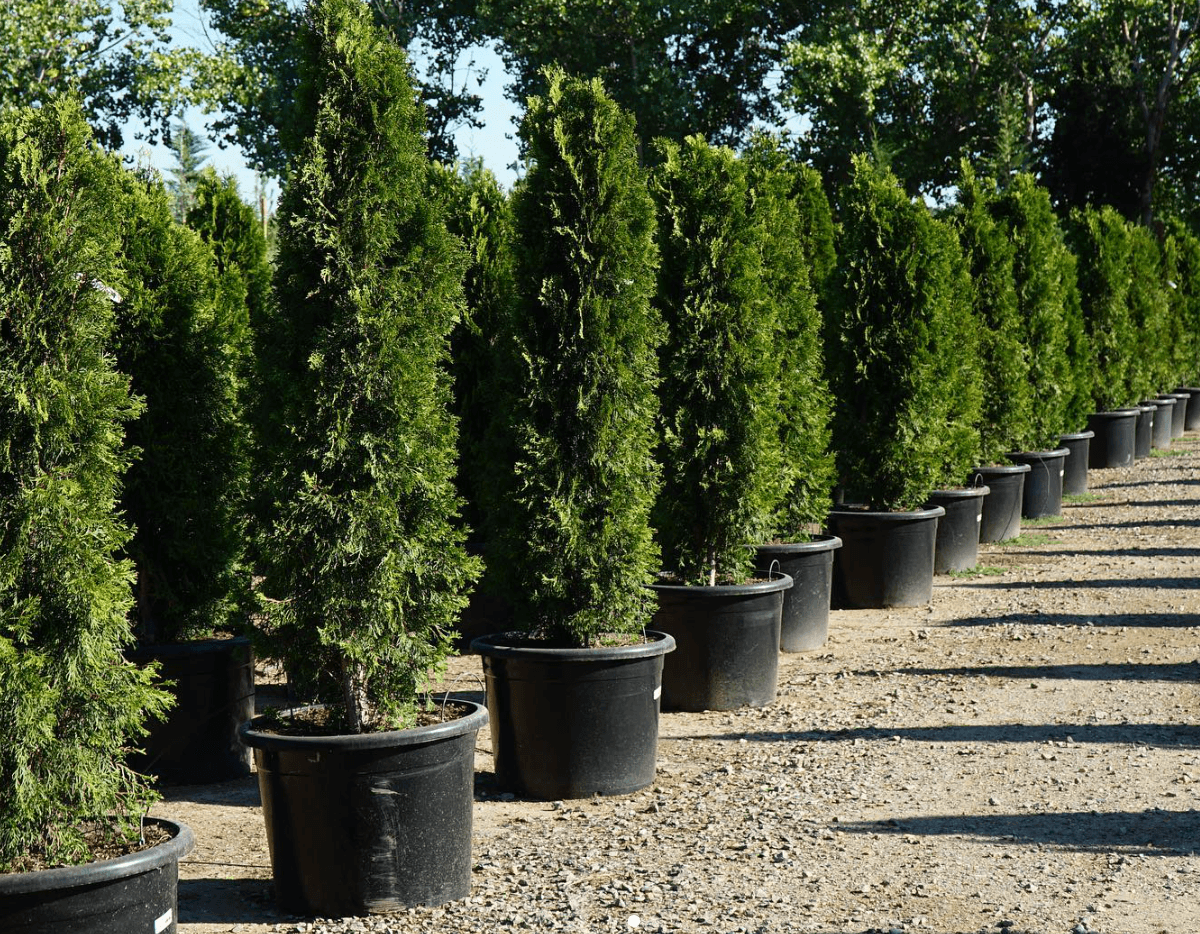
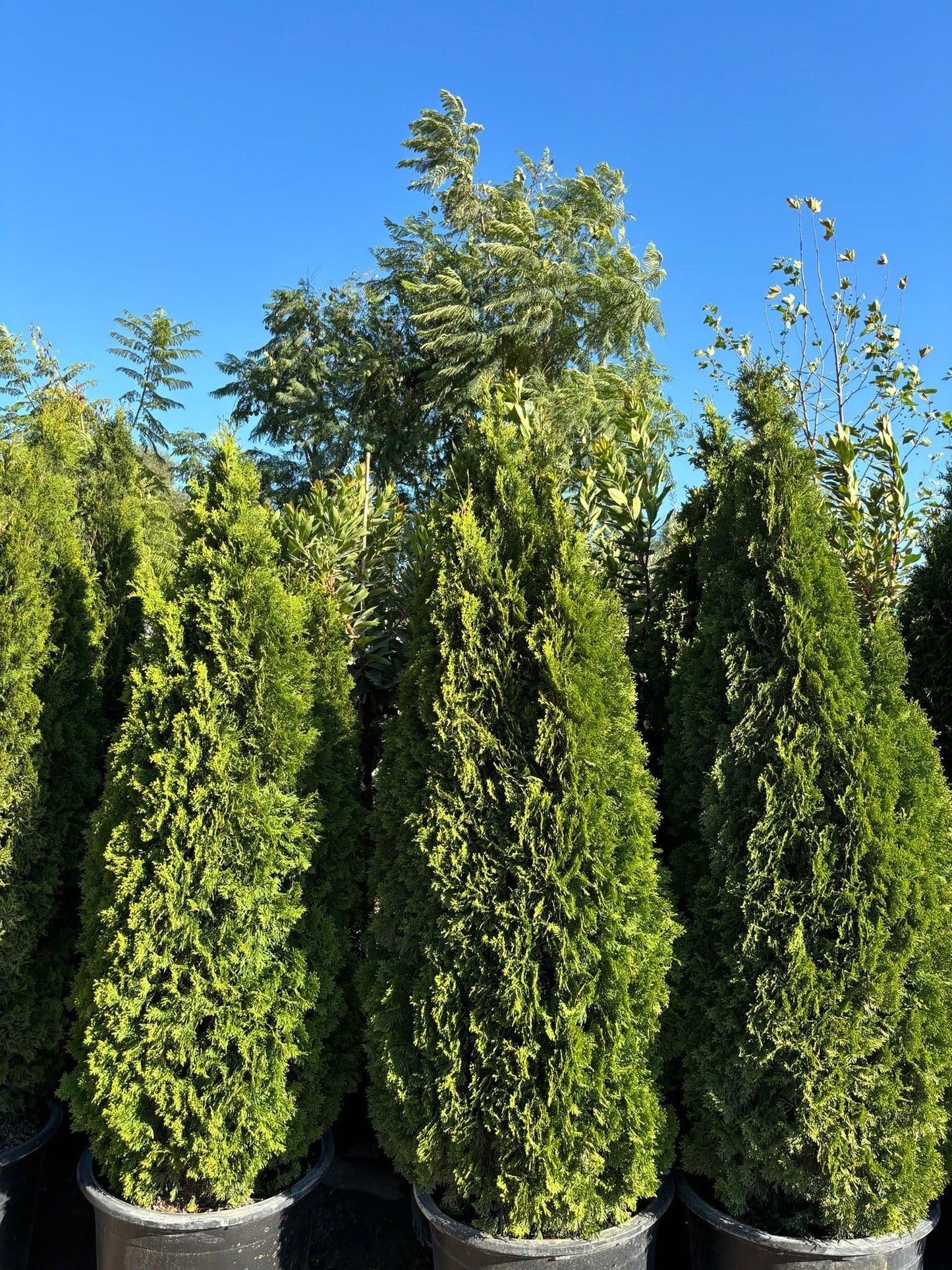
Arborvitae is a popular genus of evergreen coniferous shrubs and trees prized for dense, pyramidal growth habit, year-round greenery, and reliable screening power. Whether you need a towering privacy wall, a tight arborvitae hedge, or a compact accent plant for a foundation planting, our arborvitae collection covers the full range - from rapid growth varieties that add 3 to 4 feet per year to slow growing dwarf cultivars measured in inches. The name arborvitae means "tree of life" in French (l'arbre de vie), and these hardy evergreens earn that title by delivering year round visual interest across California's diverse microclimates.
Types of Arborvitae
Arborvitae varieties break down into three broad categories based on species, mature size, and growth rate. Understanding which type fits your landscape - and your patience - is the fastest way to narrow the selection.
American Arborvitae (Thuja occidentalis)
Also called northern white cedar or eastern white cedar, thuja occidentalis is native to eastern Canada and New England. It's the classic cold-hardy arborvitae with dense evergreen foliage arranged in flat, scale like leaves. American arborvitae can reach heights of 70 feet in its native range, though most garden arborvitae varieties grow 10 to 30 feet tall. The narrow form and dark green foliage make eastern arborvitae ideal for formal hedges and privacy screens in northern California climates where cooler winters keep these trees in their comfort zone (generally USDA Zones 2–7). Common arborvitae varieties include 'Emerald Green' and cultivars like 'Holmstrup' and 'Degroot's Spire' - all selected for tighter pyramidal shape and reliable winter color.
Giant Arborvitae (Thuja plicata)
Native to the Pacific Northwest, thuja plicata - commonly called western red cedar - is the species behind the fastest-growing arborvitae trees available. Western red cedar can reach up to 200 feet tall in the wild, though landscape specimens typically top out between 50 and 60 feet. The standout cultivar is Green Giant Arborvitae, which can grow 3 to 4 feet per year under good conditions, making it one of the best choices for fast growing trees for privacy. Giant arborvitae delivers rapid growth, dense foliage, and strong wind resistance for large-scale screening and windbreaks - provided you have the space for its 12–20 foot mature spread.
Dwarf and Compact Varieties
For small gardens, narrow spaces, containers, and rock gardens, dwarf arborvitae cultivars offer the same evergreen character in a fraction of the footprint. Globe-shaped selections like 'Mr. Bowling Ball' and 'Tater Tot' stay under 3 feet with a rounded shape, while dwarf pyramidal types like 'North Pole' grow 10 to 15 feet tall and 3 to 5 feet wide. Golden and variegated foliage cultivars such as 'Rheingold' - which shifts from gold to reddish brown through the seasons - serve as a striking focal point or accent plant alongside other landscape plants. Dwarf arborvitae may only grow a few inches annually, but they bring winter interest and year round structure with minimal maintenance.
What to Look For in Arborvitae
Choosing the right arborvitae comes down to three measurable characteristics that determine how well a plant performs in your specific site.
Mature Size and Growth Rate
Mature size is the single most important factor. Arborvitae cannot achieve a square, stately hedge shape - they grow naturally into pyramidal or conical forms, so you need to select a cultivar whose natural shape and dimensions match your space. Emerald Green Arborvitae reaches 10 to 15 feet tall with a 3–4 foot width, fitting perfectly into narrow form plantings along fences and property lines. Green Giant Arborvitae, by contrast, can exceed 50 feet tall with rapid growth - some arborvitae grow 3 to 4 feet per year - but demands far more horizontal clearance. Underestimating mature width is the most common planting mistake, leading to crowded branches, lost lower foliage, and gaps that defeat the purpose of a screen.
Foliage Density and Color
Dense foliage is what makes arborvitae effective as privacy screens, hedges, and windbreaks. Look for cultivars with thick branching all the way to the ground - this is where arborvitae hedges often develop inconsistent heights and gaps if varieties are poorly matched to the site. Color matters too: standard species produce deep green foliage, while selected cultivars range from the bright emerald green of 'Smaragd' to golden tones that add contrast against other trees and other shrubs. Keep in mind that arborvitae can struggle with winter burn, affecting appearance - cultivars like Emerald Green are bred to resist the bronzing that plagues many thuja occidentalis selections in cold or dry winter conditions.
Climate Adaptability
Arborvitae are generally hardy in USDA Zones 2–7, with thuja plicata cultivars extending into Zone 8. For California gardeners, this means coastal, northern, and mountain areas offer the most forgiving conditions. In hotter inland valleys, arborvitae require supplemental water, afternoon partial shade, and careful soil preparation. They are not very drought tolerant during establishment, though mature plants handle dry periods better. Many arborvitae varieties adapt to a variety of soils, but arborvitaes need well-drained soil to prevent root rot - heavy clay or compacted sites should be amended before planting. Arborvitae thrives in full sun to partial shade, with at least six hours of direct sunlight needed for the densest green foliage.
How to Choose the Right Arborvitae
Turning those characteristics into a decision means weighing four practical criteria against your site and goals:
- Purpose and Function - A tall privacy screen calls for fast-growing species like Green Giant or a mass planting of Emerald Green. A foundation planting or accent alongside other plants works better with dwarf or compact varieties. Arborvitae can function as windbreaks in landscaping, but only if the cultivar's mature height exceeds the area you need to protect.
- Available Space - Measure both height clearance (overhead wires, eaves, other trees) and width from fences or structures. Use the cultivar's mature width, not the size at purchase. North Pole Arborvitae at 3–5 feet wide fits small spaces where Green Giant's 12–20 foot spread would overwhelm the landscape.
- Timeline Expectations - If you want visual screening within 3–5 years, you need a cultivar with rapid growth. Fast growing hedging plants like Green Giant deliver that but require more water, space, and attention during establishment. Slow growing selections like 'Holmstrup' or globe dwarfs demand patience but far less ongoing care.
- Maintenance Preference - Arborvitae are low-maintenance and pest-resistant once established, but they do not regrow from bare interior wood. Pruning must stay within the green foliage - never cut back into branches with no new growth. If you prefer a hands-off natural shape, choose a cultivar whose untrimmed profile matches what you want. If you want tightly clipped formal hedges, commit to light, regular trimming rather than heavy annual cuts. A slow release granular fertilizer applied in early spring supports healthy new growth without forcing leggy branches.
Frequently Asked Questions
Which arborvitae grows fastest for privacy screening?
Green Giant Arborvitae is the fastest widely available option, growing 3 to 4 feet per year under optimal conditions - full sun, consistent moisture, and well-drained soil. It matures to 50–60 feet tall with a 12–20 foot spread, so it's best suited to larger properties. For tall skinny trees for privacy in tighter spaces, Emerald Green Arborvitae grows up to 15 feet tall at a more moderate 6–12 inches per year but requires far less room. Arborvitae can grow 2 to 3 feet per year depending on cultivar and conditions.
How far apart should I space arborvitae for a hedge?
Plant arborvitae 3 to 4 feet apart for hedges using narrow cultivars like Emerald Green. For larger species like Green Giant, spacing of 8–10 feet or more is necessary to avoid crowding as the trees mature. The rule of thumb: space plants at least equal to their mature width. Arborvitae are often misidentified as other hedge types because improper spacing causes them to thin out and lose their characteristic dense foliage over time.
Do arborvitae work well in California's climate?
Yes - in the right zones. Coastal, northern, and higher-elevation areas of California (roughly USDA Zones 5–8) are well suited for most arborvitae varieties. Hotter inland and southern part zones require more careful site selection: afternoon partial shade, drip irrigation to the root zone, and mulching with 2 inches of shredded bark or organic matter to retain moisture. Arborvitae are often used for year-round greenery in landscapes across the state, but they aren't the best pick for true desert conditions. If you garden in a hot, dry area, consider pairing arborvitae with other drought-tolerant shrubs or exploring alternatives like Podocarpus for sections that receive the most intense heat.
How do I care for newly planted arborvitae?
Consistent moisture is crucial for newly planted arborvitae. Water newly planted arborvitaes with one inch weekly - more frequently during hot, dry spells - for the first one to two growing seasons. When you plant arborvitae, dig the hole 2–3 times the width of the root ball but no deeper than the root ball itself; backfill carefully to eliminate air pockets. Mulch around arborvitaes with 2 inches of organic matter, keeping mulch pulled back from the trunk to prevent disease problems. Prune arborvitaes in late winter to early spring before new growth emerges. Use a slow-release fertilizer for container arborvitaes or any specimen that needs a boost during establishment. Avoid planting in midsummer heat or deep winter gardens - early spring and early fall give roots the best chance to establish before temperature extremes.
Shop Our Arborvitae Collection
Arborvitae are valued for their dense, pyramidal growth habit and ability to deliver privacy, structure, and winter interest with relatively low ongoing care. Match the cultivar to your space, timeline, and climate zone, and these trees will reward you with a broad range of landscape uses - from towering screens to compact foundation plantings.